Introducing AeroEmbed-1
A closer look at AeroAI's 0.8B-parameter aviation model, its prompt format, tool calling, and the limits that matter for safety.
AeroEmbed-1 is AeroAI's compact, 0.8-billion-parameter language model for aviation-focused tasks on devices with limited compute and memory. Its small footprint is the point: it is designed to be easier to run in constrained environments than a large general-purpose model. But compact does not mean dependable, and it should not be mistaken for a flight-ready source of truth.
At 0.8B parameters, AeroEmbed-1 has limited capacity compared with much larger language models. It can produce frequent mistakes, misunderstand instructions, or give confidently wrong responses, particularly when a question requires nuanced aviation knowledge or several reasoning steps. Size alone cannot quantify an error rate, and fine-tuning does not eliminate these limitations. In aviation, a plausible but incorrect answer about fuel, performance, weather, or procedures can have serious consequences. That makes unverified model output unacceptable for high-stakes decisions.
AeroEmbed-1 supports tool calling: it can be trained to request a tool instead of trying to supply every answer from its own generated text. A tool can provide a calculation or retrieve information, but the model still has to select the right tool, pass the right inputs, and interpret the result correctly. Tool access therefore creates a path to more useful workflows, not a guarantee of correctness.
The model also uses a specialized prompt format to distinguish instructions, tool interactions, and the response it is expected to produce. The screenshot below illustrates that structure. Formatting matters for a small model: without the expected pattern, a base model's output may be garbled, incoherent, or unrelated to the requested answer.
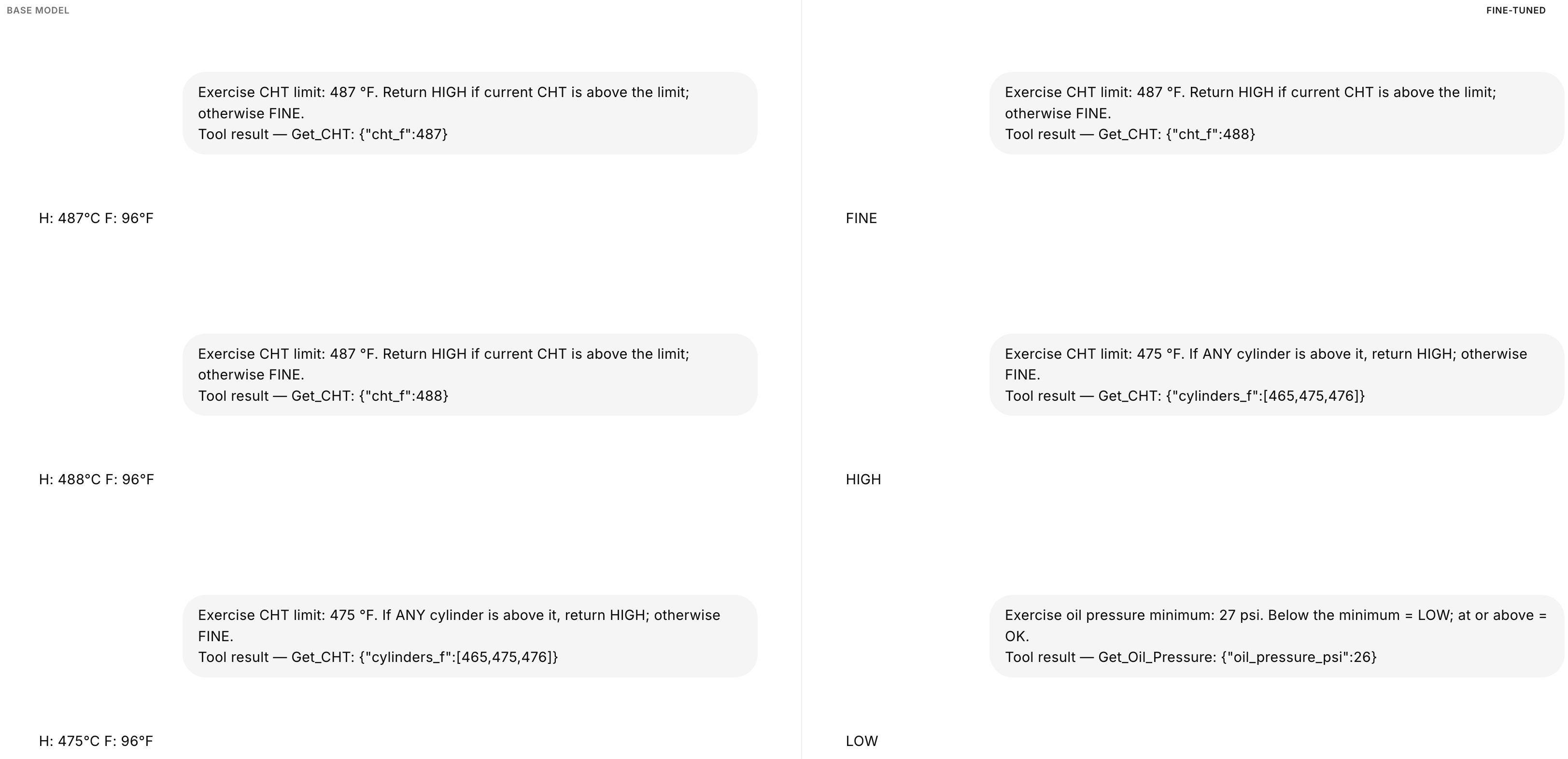
Our fine-tuning work teaches AeroEmbed-1 to follow that structure and produce more coherent, task-directed responses instead of the default model's gibberish. It aims to improve instruction following and make tool calls usable in context; it does not turn a 0.8B-parameter model into an authoritative aviation advisor. The difference between a formatted, fine-tuned response and raw base-model output is a meaningful development step, not proof of operational reliability.
AeroEmbed-1 should be treated as an experimental, assistive model. Aviation answers require verification against current authoritative sources, validated calculations, and qualified human judgment. Before any operational use, the model and its tool workflow need task-specific evaluation, failure analysis, and safeguards that prevent uncertain or incorrect output from being relied upon in flight-critical situations.